SHOUG FAWAZ ABDULLAH ALOMRAN
ALJOHARAH WALEED A ALBAWARDI
YARA MUTLAQ MOHAMMED ALZAMEL
FAI MOHAMMAD BIN KHANJAR
SHOUG FAWAZ ABDULLAH ALOMRAN
ALJOHARAH WALEED A ALBAWARDI
YARA MUTLAQ MOHAMMED ALZAMEL
FAI MOHAMMAD BIN KHANJAR
Table of Contents
Jump to any section of the report:
جدول المحتويات
انتقل إلى أي قسم في التقرير:
1. Introduction
In today's digital world, secure communication is the need of the hour
to protect sensitive information being exchanged over public networks.
The Diffie-Hellman key exchange algorithm allows two parties to agree
on a shared secret key without actually exchanging it, and forms a
basis for many of today's encryption schemes.
The following Java code for the Diffie–Hellman implementation is
provided for CS285, Discrete Mathematics for Computing. The developed
system incorporates fundamental mathematical concepts regarding
modular arithmetic and exponentiation. The system simulates secure key
generation and exchange between two entities using the Diffie–Hellman
key exchange method. A simple encryption and decryption mechanism has
also been provided to illustrate how the derived shared key can be
used to secure messages.
We divide the program into the following classes: Parameters handles
all public values, KeyExchange generates and computes keys, Encryptor
encrypts messages, and Validator, Helpers, and Utils ensure correct
input handling and output formatting. The Main class integrates all
components of the system and allows users to test both a predefined
numerical example and a live interactive mode.
The project ties together theoretical mathematics and programming in
practice, showing how secure key exchange and encryption work in
real-world systems.
1. المقدمة
في عالمنا الرقمي اليوم أصبحت الاتصالات الآمنة ضرورة لحماية المعلومات
الحساسة التي يتم تبادلها عبر الشبكات العامة. تتيح خوارزمية تبادل
المفاتيح ديفي–هيلمان لطرفين الاتفاق على مفتاح سري مشترك دون تبادله
بشكل مباشر، وهي أساس لكثير من أنظمة التشفير الحديثة.
تقدم شيفرة جافا التالية كتطبيق لطريقة ديفي–هيلمان ضمن مقرر CS285
(الرياضيات المتقطعة للحوسبة). يعتمد النظام على مفاهيم رياضية أساسية
مثل الحساب المعياري والأسس. يحاكي النظام توليد المفاتيح وتبادلها بشكل
آمن بين كيانين باستخدام ديفي–هيلمان، كما يتضمن آلية بسيطة للتشفير وفك
التشفير لتوضيح كيفية استخدام المفتاح المشترك لحماية الرسائل.
تم تقسيم البرنامج إلى عدة أصناف: يتولى Parameters القيم
العامة، ويقوم KeyExchange بتوليد وحساب المفاتيح، ويقوم
Encryptor بتشفير الرسائل، بينما تضمن Validator و
Helpers و Utils صحة المدخلات وتنسيق المخرجات. يقوم
الصنف Main بدمج جميع المكونات ويوفر وضع المثال العددي ووضعا
تفاعليا مباشرا.
يربط هذا المشروع بين النظرية الرياضية والتطبيق البرمجي لإظهار كيفية
عمل تبادل المفاتيح والتشفير في الأنظمة الواقعية.
1.1 Purpose of the Diffie–Hellman Key Exchange and Its Applications
The Diffie-Hellman key exchange is a cryptography technique whose main
purpose is to allow two parties to exchange a key that can be used for
encrypting messages. This shared key can be used in public channels
that ensures no one unauthorized can read it. The key concept was
developed by Ralph Merkle but was published by Whitfield Diffie and
Martin Hellman in 1976, which is why it's named after them.
Real-World Applications
-
TLS: DH variants during the handshake generate
session keys that protect web traffic.
-
SSH: Establishes a secret key early in the
connection to secure commands and file transfers.
-
Royal Convoy Security: Vehicles and control
centers coordinate securely using a DH-family exchange.
1.1 الهدف من تبادل مفاتيح ديفي–هيلمان وتطبيقاته
يعد تبادل مفاتيح ديفي–هيلمان أسلوبا في علم التشفير يهدف إلى تمكين
طرفين من إنشاء مفتاح مشترك يمكن استخدامه لتشفير الرسائل. يتم إنشاء
المفتاح عبر قناة عامة بحيث لا يستطيع غير المصرح لهم استخلاصه. طورت
الفكرة الأساسية بواسطة رالف ميركل، ثم نشرت رسميا بواسطة ويتفيلد ديفي
ومارتن هيلمان عام 1976، ومن هنا جاءت التسمية.
تطبيقات واقعية
-
TLS: تستخدم أشكال DH أثناء المصافحة لإنشاء مفاتيح
جلسة تحمي حركة الويب.
-
SSH: ينشئ مفتاحا سريا في بداية الاتصال لتأمين
الأوامر ونقل الملفات.
-
أمن المواكب: يمكن للمركبات ومراكز التحكم التنسيق
بشكل آمن باستخدام تبادل من عائلة DH.
1.2 Algorithm Explanation
The Diffie–Hellman key exchange algorithm allows two parties to create
a common secret over insecure channels by performing modular
exponentiation on agreed public parameters.
How It Works
-
Agree on prime q and generator (primitive root)
α.
-
Choose private keys Xa and
Xb with 1 ≤ X < q−1.
-
Compute public keys: Ya = αXa mod q,
Yb = αXb mod q.
- Exchange Ya and Yb.
-
Compute shared secret:
k = YbXa mod q = YaXb mod q.
Even though q, α, Ya, and Yb are public, inferring Xa or Xb is
computationally infeasible for large, well-chosen parameters due to
the Discrete Logarithm Problem.
1.2 شرح الخوارزمية
تمكن خوارزمية ديفي–هيلمان طرفين من إنشاء سر مشترك عبر قناة غير آمنة من
خلال إجراء عمليات الأسس المعيارية على معلمات عامة يتم الاتفاق عليها
مسبقا.
كيف تعمل
-
الاتفاق على عدد أولي q ومولد (جذر بدائي)
α.
-
اختيار مفاتيح خاصة Xa و Xb بحيث
1 ≤ X < q−1.
-
حساب المفاتيح العامة: Ya = αXa mod q و
Yb = αXb mod q.
- تبادل Ya و Yb.
-
حساب السر المشترك:
k = YbXa mod q = YaXb mod q.
رغم أن q و α و Ya و Yb قيم عامة، فإن استنتاج Xa أو Xb غير عملي حسابيا
عند استخدام معلمات كبيرة ومختارة بشكل صحيح بسبب صعوبة مسألة اللوغاريتم
المتقطع.
1.3 Numerical Example
Two cars and a control center must communicate securely during a royal
convoy.
Step-by-Step Calculation
-
Public parameters: q = 23,
α = 5.
-
Car 1 chooses Xa = 6 →
Ya = 56 mod 23 = 8.
-
Car 2 chooses Xb = 15 →
Yb = 515 mod 23 = 19.
- Exchange Ya and Yb.
-
Shared secret: Car 1 → 196 mod 23 = 2; Car 2 →
815 mod 23 = 2.
- Both derive the same key: 2.
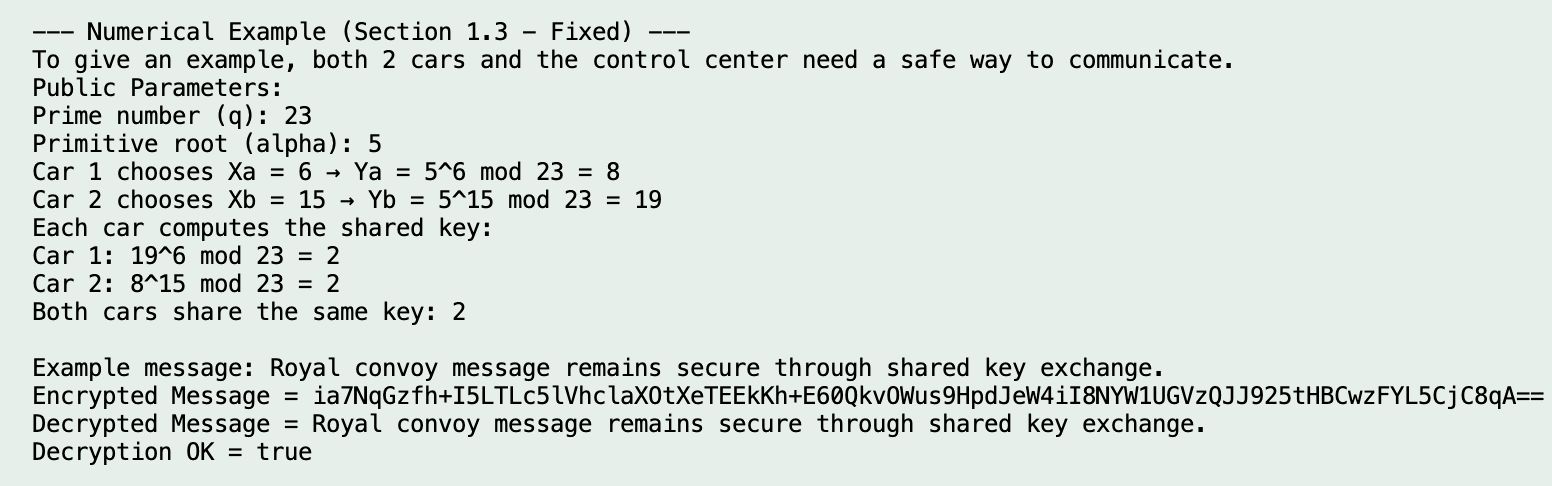
Numerical example with fixed values (q=23, α=5).
1.3 مثال عددي
تحتاج سيارتان ومركز تحكم إلى التواصل بشكل آمن أثناء موكب رسمي.
الحساب خطوة بخطوة
-
المعلمات العامة: q = 23 و α = 5.
-
تختار السيارة 1 Xa = 6 →
Ya = 56 mod 23 = 8.
-
تختار السيارة 2 Xb = 15 →
Yb = 515 mod 23 = 19.
- يتم تبادل Ya و Yb.
-
السر المشترك: السيارة 1 → 196 mod 23 = 2 وال
سيارة 2 → 815 mod 23 = 2.
- يتوصل الطرفان إلى نفس المفتاح: 2.
مثال عددي بقيم ثابتة (q=23 و α=5).
1.4 Advantages and Limitations of Diffie–Hellman
Strengths of Diffie–Hellman
-
No pre-shared secret: Two parties can securely
derive a shared key over a public channel.
-
Forward secrecy (with ephemeral keys): New
private keys per session protect past communications.
-
Mathematical soundness: Security rests on the
Discrete Logarithm Problem (DLP).
-
Widely implemented: A proven cornerstone of
secure protocols for decades.
Limitations of Diffie–Hellman
-
No authentication by default: Vulnerable to
MitM unless combined with certificates or signatures.
-
Weak parameter selection: Small or reused
primes can enable precomputation attacks.
-
Performance overhead: Large modular
exponentiations are heavy vs symmetric crypto.
While Diffie–Hellman provides a strong mathematical basis for key
exchange, its security depends on careful parameter management and the
inclusion of authentication to avoid interception or impersonation.
1.4 المزايا والقيود في ديفي–هيلمان
نقاط القوة
-
لا يحتاج سرا مسبقا: يمكن لطرفين اشتقاق مفتاح
مشترك عبر قناة عامة.
-
سرية أمامية (مع مفاتيح مؤقتة): مفاتيح جديدة لكل
جلسة تحمي الاتصالات السابقة.
-
متانة رياضية: الأمان قائم على صعوبة مسألة
اللوغاريتم المتقطع.
-
شائع الاستخدام: حجر أساس في بروتوكولات الأمان
منذ عقود.
القيود
-
بدون توثيق افتراضي: قابل لهجوم الرجل في الوسط
ما لم يدمج مع شهادات أو توقيعات.
-
اختيار معلمات ضعيف: استخدام أعداد أولية صغيرة
أو معاد استخدامها قد يسهل هجمات الاستباق الحسابي.
-
عبء أداء: عمليات الأسس المعيارية الكبيرة أبطأ
مقارنة بالتشفير المتماثل.
رغم أن ديفي–هيلمان يقدم أساسا رياضيا قويا لتبادل المفاتيح، إلا أن
الأمان يعتمد على إدارة المعلمات بعناية وإضافة طبقة توثيق لتجنب
الاعتراض أو الانتحال.
1.5 Comparison Between Diffie–Hellman (DH) and Elliptic Curve
Diffie–Hellman (ECDH)
Elliptic Curve Diffie–Hellman (ECDH) follows the same principle as DH
but replaces modular arithmetic with elliptic-curve mathematics,
providing stronger security with smaller key sizes.
Shared Principles
-
Both allow two parties to establish a shared secret without prior
key exchange.
-
Security relies on computational hardness problems: DLP (DH) and
ECDLP (ECDH).
-
Neither provides authentication by itself; must be combined with
signatures or certificates.
- Both can achieve forward secrecy using ephemeral key pairs.
Key Differences
-
Security per bit: ECDH achieves equivalent
security with smaller key sizes.
-
Performance: ECDH is typically faster and lighter
on constrained devices.
-
Parameter handling: DH uses primes and
generators; ECDH uses standardized curves.
-
Resistance to precomputation: Curves reduce
feasibility of mass precomputation attacks.
-
Deployment: ECDH dominates modern protocols
(e.g., TLS 1.3).
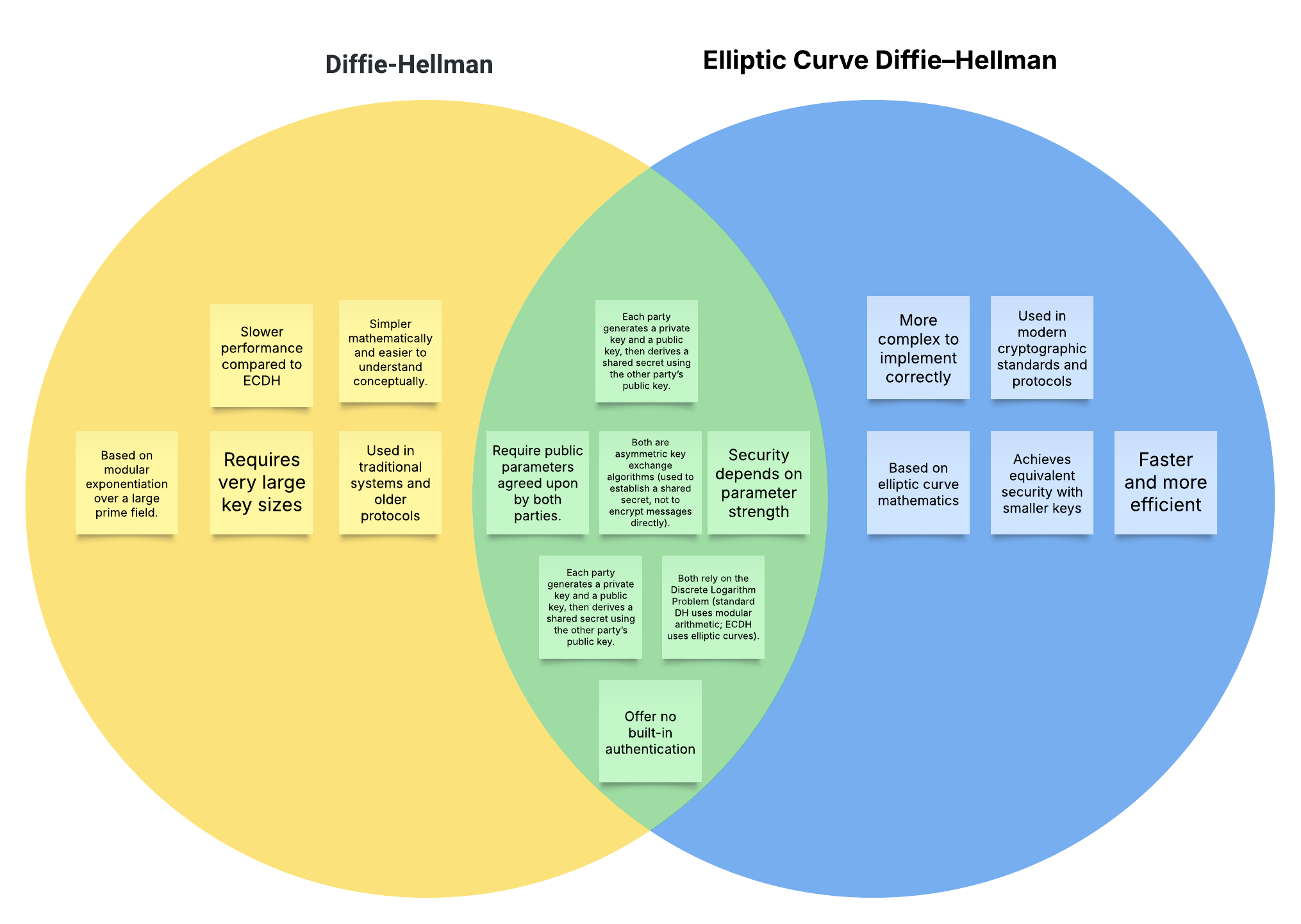
Overlap between DH and ECDH.
1.5 مقارنة ديفي–هيلمان (DH) مع ديفي–هيلمان بالمنحنيات الإهليلجية
(ECDH)
يتبع ECDH نفس مبدأ DH لكنه يستبدل الحساب المعياري برياضيات المنحنيات
الإهليلجية، مما يوفر أمانا أعلى بمفاتيح أصغر.
مبادئ مشتركة
- كلاهما يمكن طرفين من إنشاء سر مشترك دون تبادل مفتاح مسبقا.
-
يعتمد الأمان على مسائل صعبة حسابيا: DLP في DH و ECDLP في ECDH.
-
لا يوفر أي منهما توثيقا بذاته؛ يجب دمجه مع توقيعات أو شهادات.
- يمكن تحقيق السرية الأمامية باستخدام مفاتيح مؤقتة.
أهم الفروقات
-
الأمان لكل بت: يحقق ECDH أمانا مكافئا بمفاتيح
أصغر.
-
الأداء: غالبا ما يكون ECDH أسرع وأخف على الأجهزة
محدودة الموارد.
-
إدارة المعلمات: يعتمد DH على اختيار q و α، بينما
يستخدم ECDH منحنيات معيارية.
-
مقاومة الاستباق الحسابي: تقل قابلية هجمات
الاستباق واسعة النطاق مع المنحنيات.
-
الانتشار: يهيمن ECDH على البروتوكولات الحديثة
(مثل TLS 1.3).
منطقة التقاطع بين DH و ECDH.
2. Code Description
2.1 How the Program Works
The program is organized into classes: Main (driver),
Parameters (public values q and α),
KeyExchange (private/public keys and shared secret),
Encryptor (demo XOR encryption keyed by SHA-256(shared
secret)), Validator (prime/range/message validations),
Utils (helpers), and Helpers (interactive prompts).
2. وصف الشيفرة
2.1 كيف يعمل البرنامج
يتكون البرنامج من عدة أصناف: Main (المشغل)،
Parameters (القيم العامة q و α)،
KeyExchange (المفاتيح الخاصة والعامة والسر المشترك)،
Encryptor (تشفير XOR توضيحي مع مفتاح مشتق من SHA-256 للسر
المشترك)، Validator (التحقق من القيم)،
Utils (مساعدات عامة)، و Helpers (مطالبات تفاعلية).
2.2 Implementation of Each Part
Key Generation
private void generateKeys() { this.privateKey = new
BigInteger(getQ().bitLength(), random)
.mod(getQ().subtract(BigInteger.TWO)) .add(BigInteger.ONE); // 1 <=
x <=q-2 this.publicKey=getAlpha().modPow(privateKey, getQ()); //
Y=α^x mod q }
The private key is uniform in [1, q−2]. The public key is computed as
Y = α^x mod q.
Encryption
String encrypt(String msg, BigInteger sharedKey) throws Exception {
byte[] msgByte = msg.getBytes(StandardCharsets.UTF_8); byte[]
keyByte = Key(sharedKey); // SHA-256 hash of shared key byte[]
cipherMsgByte = xor(msgByte, keyByte); // demo XOR cipher return
Base64.getEncoder().encodeToString(cipherMsgByte); }
For demonstration, we hash the shared secret to a fixed-length byte
key and XOR the plaintext bytes, then Base64-encode.
Decryption
String decrypt(String base64cipherMsg, BigInteger sharedKey) throws
Exception { byte[] keyByte = Key(sharedKey); byte[] cipherMsgByte =
Base64.getDecoder().decode(base64cipherMsg); byte[] msgByte =
xor(cipherMsgByte, keyByte); return new String(msgByte,
StandardCharsets.UTF_8); }
Using the same hash and XOR reverses the demo cipher and recovers the
message.
2.2 تفاصيل التنفيذ
توليد المفاتيح
private void generateKeys() { this.privateKey = new
BigInteger(getQ().bitLength(), random)
.mod(getQ().subtract(BigInteger.TWO)) .add(BigInteger.ONE); // 1 <=
x <=q-2 this.publicKey=getAlpha().modPow(privateKey, getQ()); //
Y=α^x mod q }
يتم اختيار المفتاح الخاص بشكل منتظم ضمن المجال [1, q−2]، ثم يحسب
المفتاح العام وفق Y = α^x mod q.
التشفير
String encrypt(String msg, BigInteger sharedKey) throws Exception {
byte[] msgByte = msg.getBytes(StandardCharsets.UTF_8); byte[]
keyByte = Key(sharedKey); // SHA-256 hash of shared key byte[]
cipherMsgByte = xor(msgByte, keyByte); // demo XOR cipher return
Base64.getEncoder().encodeToString(cipherMsgByte); }
لأغراض التوضيح، يتم تجزئة السر المشترك لإنتاج مفتاح بطول ثابت ثم إجراء
XOR على بايتات النص، وبعدها ترميز الناتج بصيغة Base64.
فك التشفير
String decrypt(String base64cipherMsg, BigInteger sharedKey) throws
Exception { byte[] keyByte = Key(sharedKey); byte[] cipherMsgByte =
Base64.getDecoder().decode(base64cipherMsg); byte[] msgByte =
xor(cipherMsgByte, keyByte); return new String(msgByte,
StandardCharsets.UTF_8); }
استخدام نفس التجزئة وعملية XOR يعكس التشفير ويسترجع الرسالة الأصلية.
2.3 Challenges Faced and How We Overcame Them
Input Validation
Non-prime q, invalid α ranges, or short messages previously crashed
the program; robust prompting loops now enforce constraints and
re-ask on error.
Class Integration
Standardized method names and types across modules to simplify the
Main driver and reduce coupling issues.
Modular Arithmetic Accuracy
Adopted Java’s modPow to avoid overflow and correctness
issues for public/shared key derivations.
Byte Handling Consistency
Enforced UTF-8 and Base64 to keep encryption/decryption round-trips
stable across platforms.
2.3 التحديات وكيف تم تجاوزها
التحقق من المدخلات
كانت القيم غير الأولية لـ q أو قيم α خارج النطاق أو الرسائل القصيرة
تسبب أعطالا؛ تمت إضافة حلقات إدخال تتحقق من الشروط وتعيد الطلب عند
الخطأ.
تكامل الأصناف
تم توحيد أسماء الدوال وأنواع البيانات بين المكونات لتبسيط الصنف Main
وتقليل التشابك.
دقة الحسابات المعيارية
تم الاعتماد على modPow في جافا لتجنب مشاكل الفيض وضمان
صحة اشتقاق المفاتيح.
ثبات معالجة البايتات
تم اعتماد UTF-8 و Base64 لضمان ثبات عملية التشفير وفك التشفير عبر
المنصات.
3. Results and Test Cases
Live Mode – Manual
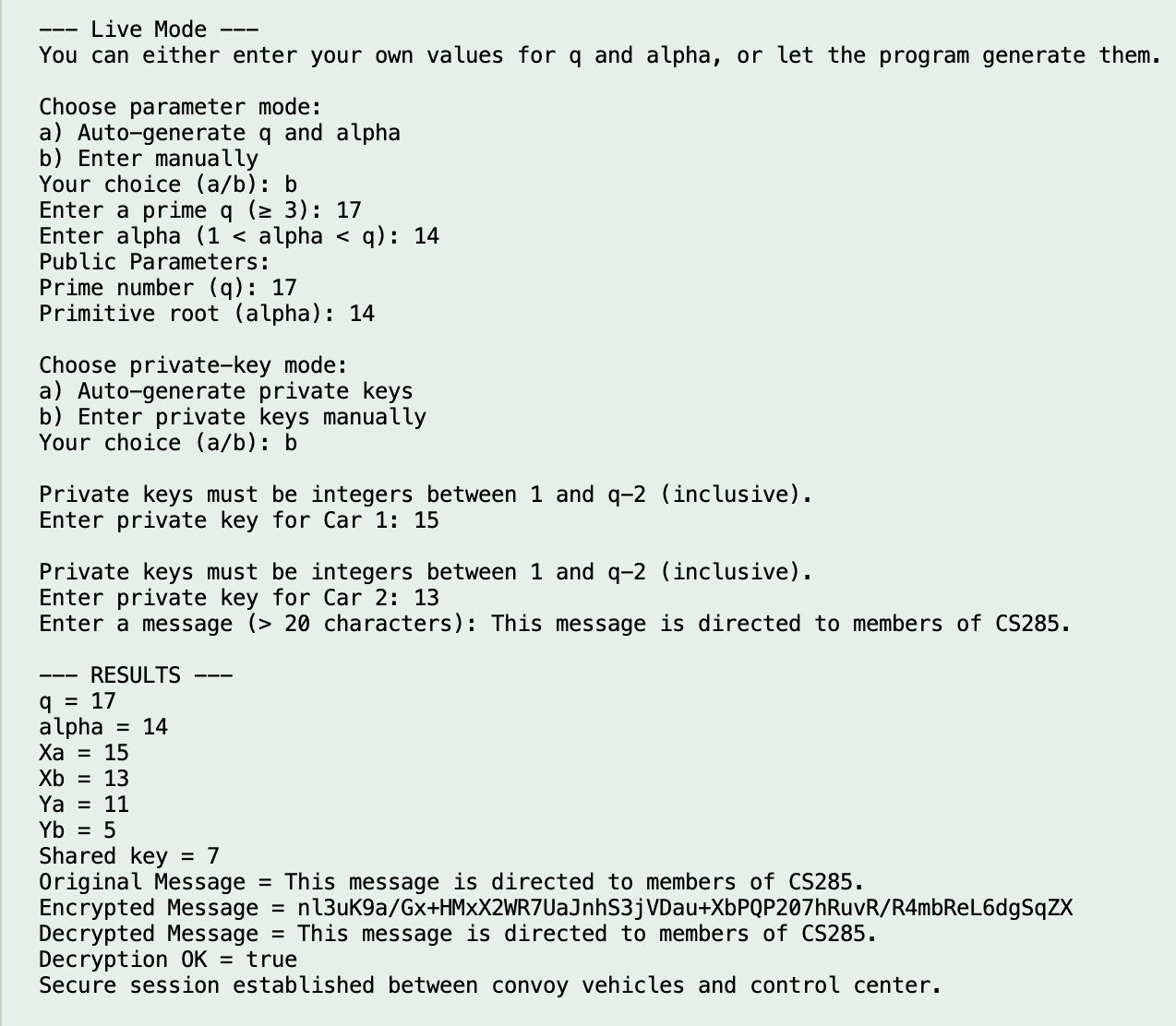
Manual input of q, α, and message – valid parameters and correct key
exchange.
In manual live mode, users provide q, α, and the message. The program
validates inputs, computes public keys, derives the shared key,
encrypts, and then decrypts the message. Successful decryption
confirms both parties derived the same shared key.
Observation
This confirms that the program correctly implements the mathematical
logic of the Diffie–Hellman key exchange algorithm.
Live Mode – Alpha Error
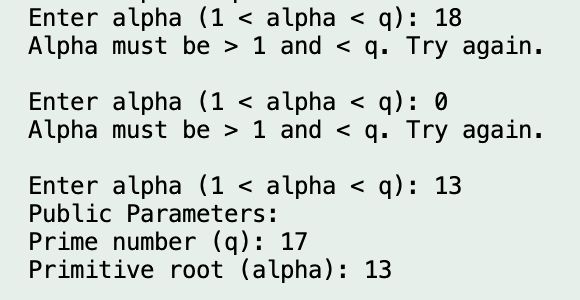
Invalid α range, the system rejects and re-prompts until valid.
This test demonstrates input validation. If α is outside (1 < α
< q), the program rejects it and re-prompts, preventing invalid
configurations.
Validation Mechanism
The Validator and Helpers classes enforce
constraints for q and α before continuing.
Numerical Example (Fixed)
Fixed small integer example – both users derive identical shared key
(K).
This example uses small integer values to visually demonstrate how two
users derive the same shared secret key.
3. النتائج وحالات الاختبار
الوضع المباشر – يدوي
إدخال يدوي لـ q و α والرسالة – معلمات صحيحة وتبادل مفاتيح سليم.
في الوضع المباشر اليدوي، يقوم المستخدم بإدخال q و α والرسالة. يتحقق
النظام من صحة المدخلات، ثم يحسب المفاتيح العامة ويشتق المفتاح المشترك
ويجري التشفير وفك التشفير. نجاح فك التشفير يثبت أن الطرفين حصلا على
نفس المفتاح.
ملاحظة
يؤكد ذلك أن البرنامج يطبق المنطق الرياضي لتبادل مفاتيح ديفي–هيلمان
بشكل صحيح.
الوضع المباشر – خطأ في α
قيمة α غير صحيحة، يتم رفضها وإعادة الطلب حتى تصبح ضمن النطاق.
توضح هذه الحالة التحقق من المدخلات. إذا كانت α خارج (1 < α < q)
يتم رفضها وإعادة الطلب لتجنب إعدادات غير صحيحة.
آلية التحقق
تعمل Validator و Helpers على فرض الشروط
الخاصة بـ q و α قبل المتابعة.
مثال عددي (ثابت)
مثال بأعداد صغيرة – يحصل الطرفان على نفس المفتاح المشترك (K).
يستخدم هذا المثال أعدادا صغيرة لتوضيح كيفية اشتقاق نفس السر المشترك
بصريا.
4. Team Contribution
All members collaborated on the Java implementation and the report.
Roles below summarize primary ownership while acknowledging shared
reviews and integration work.
Yara Alzamel
Established program scaffolding for public parameters and helper
routines, including generation of q and α and formatted output
utilities.
Fai Bin Khanjar
Implemented DH mathematics (private/public/shared keys) and authored
the guided numerical example; validated modular arithmetic
correctness.
Aljoharah Albawardi
Built the encryption/decryption demo atop the shared secret and
executed test runs; documented security considerations.
Shoug Alomran
Integrated modules into the driver, implemented validations and
resilient input loops, coordinated final testing, and unified the
report tone and structure.
4. مساهمة الفريق
ساهم جميع الأعضاء في تنفيذ المشروع بلغة جافا وإعداد التقرير. توضح
النقاط التالية المسؤوليات الأساسية مع الإشارة إلى العمل الجماعي في
المراجعة والدمج.
Yara Alzamel
إنشاء هيكل البرنامج للقيم العامة والدوال المساعدة بما يشمل توليد q و
α وتنسيق المخرجات.
Fai Bin Khanjar
تنفيذ رياضيات DH (المفاتيح الخاصة والعامة والمشتركة) وكتابة المثال
العددي والتحقق من صحة الحسابات.
Aljoharah Albawardi
بناء تجربة التشفير وفك التشفير بالاعتماد على المفتاح المشترك وتنفيذ
حالات الاختبار وتوثيق اعتبارات الأمان.
Shoug Alomran
دمج المكونات في المشغل وتطبيق التحقق من المدخلات وتنظيم الاختبارات
النهائية وتوحيد أسلوب التقرير وبنيته.
5. Conclusion
The project demonstrates how two parties can establish a shared secret
over an insecure network using modular exponentiation and carefully
validated parameters. It also highlights the importance of
authentication wrappers and ephemeral keys to achieve practical
security goals.
Future Growth Opportunities
Extend with authenticated key exchange, replace the demo XOR with
AES-GCM using a KDF, and add ECDH support with standardized curves.
5. الخاتمة
يوضح المشروع كيفية تمكين طرفين من إنشاء سر مشترك عبر شبكة غير آمنة
باستخدام الأسس المعيارية ومعلمات تم التحقق منها بعناية. كما يبرز أهمية
إضافة التوثيق والمفاتيح المؤقتة لتحقيق أهداف أمان عملية.
فرص التطوير مستقبلا
إضافة تبادل مفاتيح موثق، واستبدال XOR التوضيحي بـ AES-GCM باستخدام
KDF، وإضافة دعم ECDH عبر منحنيات معيارية.
6. References and Resources
Ambatipudi, S. (2024, June 6). Cryptographic advancements enabled by
Diffie–Hellman. ISACA Journal, Volume 3.
Boneh, D., & Shparlinski, I. E. (2001). On the unpredictability of
bits of the Elliptic Curve Diffie–Hellman scheme. CRYPTO 2001.
Springer.
Diffie, W., & Hellman, M. E. (1976). New directions in
cryptography. IEEE Transactions on Information Theory, 22(6), 644–654.
Haakegaard, R., & Lang, J. (2015). The Elliptic Curve
Diffie–Hellman (ECDH). UCSB.
Krawczyk, H. (2005). HMQV: A High-Performance Secure Diffie-Hellman
Protocol. Springer.
6. المراجع والموارد
Ambatipudi, S. (2024, June 6). Cryptographic advancements enabled by
Diffie–Hellman. ISACA Journal, Volume 3.
Boneh, D., & Shparlinski, I. E. (2001). On the unpredictability of
bits of the Elliptic Curve Diffie–Hellman scheme. CRYPTO 2001.
Springer.
Diffie, W., & Hellman, M. E. (1976). New directions in
cryptography. IEEE Transactions on Information Theory, 22(6), 644–654.
Haakegaard, R., & Lang, J. (2015). The Elliptic Curve
Diffie–Hellman (ECDH). UCSB.
Krawczyk, H. (2005). HMQV: A High-Performance Secure Diffie-Hellman
Protocol. Springer.
Appendix – Full Source Code
/* Keep your full code here exactly as-is. Code blocks are identical
in both languages. */
الملحق – الشيفرة المصدرية الكاملة
/* ضع الشيفرة كاملة هنا كما هي. الشيفرة لا تحتاج ترجمة. */